

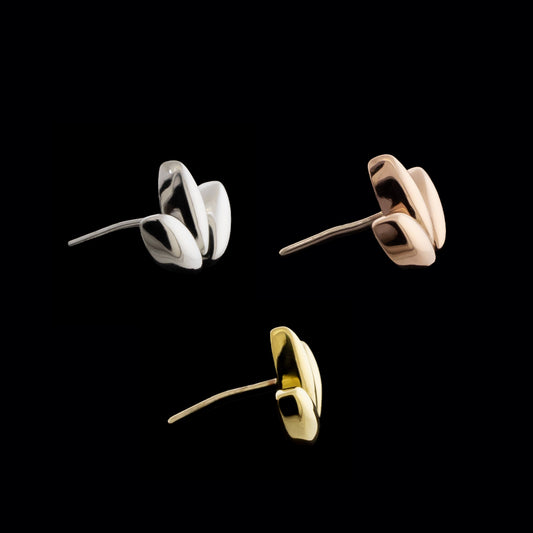

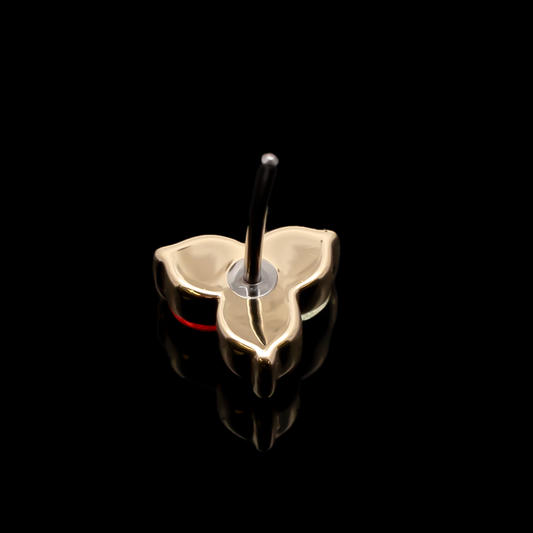
18K Gold Threadless Trinity Ends: Three Gems, One Solid Gold Statement
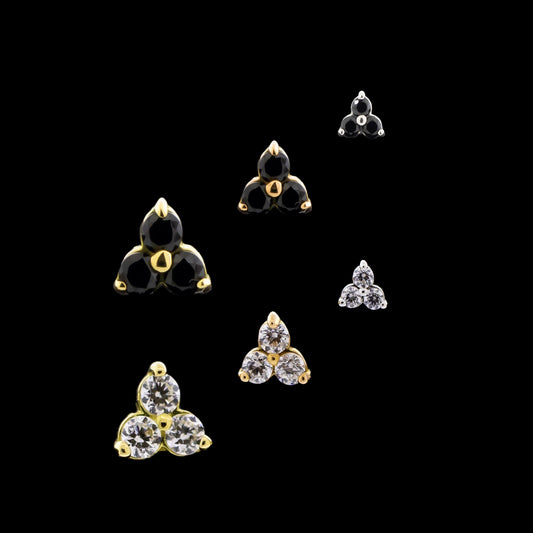
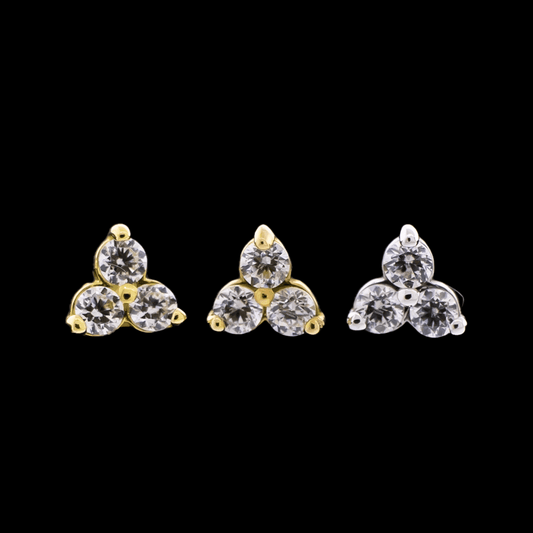
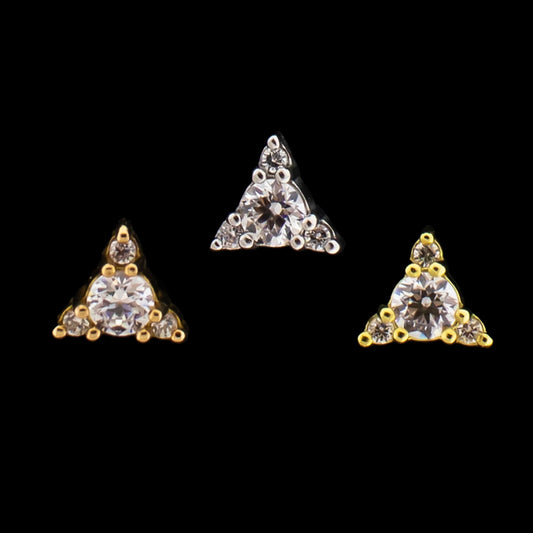
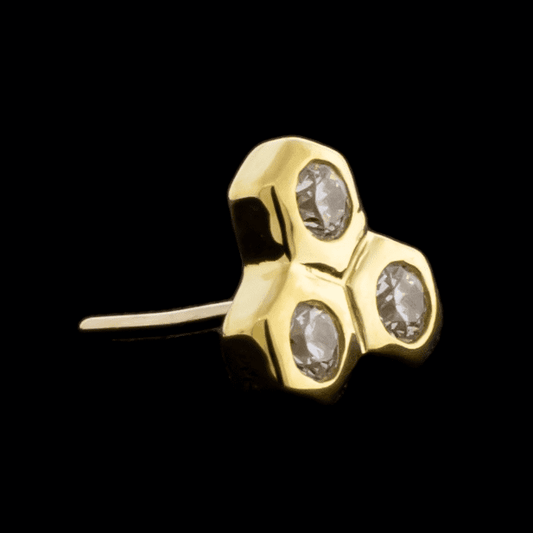
Not every threadless end earns its place in a refined piercing collection. The Khrysos 18k gold threadless trinity end does. Three prong-set premium cubic zirconia gems set in solid 18KT gold, available in yellow, white, and rose gold, with a 25G ASTM F-136 titanium pin that fits all major threadless post systems. APP-verified, 750-hallmarked, and built to the standard that serious piercers and collectors recognize.
Shop 18K Gold Threadless Trinity Ends by Gold Color
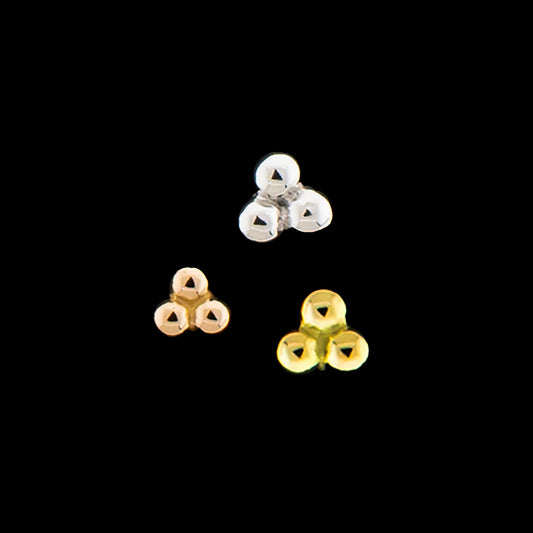
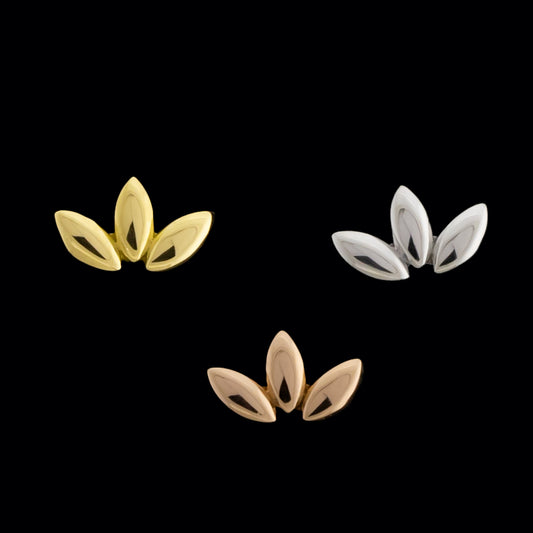
The Khrysos 18k gold threadless trinity ends come in three distinct gold colors, each with its own alloy composition and visual character. Choosing the right one starts with understanding how each reads on skin and in a curated stack.
Yellow Gold Trinity End
The yellow gold trinity end delivers the warmth that defines classic 18K gold. At 75% pure gold content, the yellow tone is richer and deeper than 14K, reading as unambiguously fine jewelry. It suits warm-to-neutral skin tones and anchors naturally in any ear stack where a classic, enduring look is the goal. This is the most recognizable form of the 18k gold threadless trinity design and the one most often chosen by piercers stocking a premium tier option for clients.
White Gold Trinity End
The white gold trinity end carries a cool, silver-like finish that reads modern and precise. A critical material detail: Khrysos white gold is alloyed with palladium, not nickel, making it fully nickel-free throughout. This distinction matters directly for anyone with metal sensitivities. Many brands use nickel in white gold alloys. Khrysos does not, which means the white gold gold threadless end is as safe for sensitive skin as the yellow or rose gold options. It pairs cleanly with titanium posts and suits cool or neutral skin tones.
Rose Gold Trinity End
The rose gold trinity end adds a warm blush tone that has become one of the most consistently requested colors in ear curation. The copper alloy component creates a subtle warmth that sits between yellow gold and white gold in the spectrum. It pairs naturally with both yellow gold and titanium pieces in the same stack and suits warm and neutral skin tones. In ear projects that mix metal colors deliberately, rose gold trinity ends serve as the transitional piece that ties warm and cool tones together.
Note: Pricing on all 18KT solid gold trinity ends may vary in line with global gold market prices. For the most current pricing and personalized advice on color selection, please contact us directly before placing your order.
What Makes the Trinity Design a Classic?
The trinity design has persisted as one of the most consistently popular silhouettes in both fine jewelry and body piercing for a clear reason: three prong-set gems in a compact cluster carry far more visual weight than their physical size suggests.
The Tri-Gem Cluster: Design Logic and Visual Impact
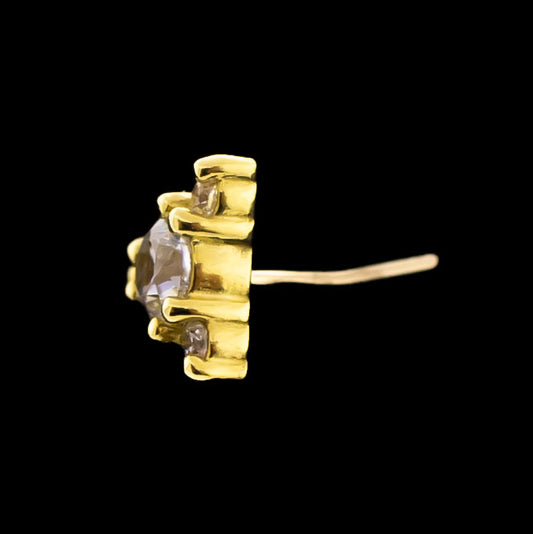
Three premium cubic zirconia stones, each held by individual prongs, are arranged in a triangular or close cluster formation. The prong-set construction maximizes gem exposure, allowing light to enter from multiple angles and reflect outward with more brilliance than a bezel-set or flush-set stone of the same size. The result is a threadless end jewelry piece compact enough for an 18G helix but visually present enough to anchor the focal point of a multi-piece ear project. The combination of 18KT gold prongs and premium CZ stones means the sparkle registers clearly even in indoor light, where many threadless ends read as flat.
Trinity End Placement Guide
The same 18k gold threadless trinity end reads differently across placements, which is what makes it one of the most versatile pieces in the Khrysos lineup. In a lobe piercing, the three gems face directly forward, creating a clean and classic stud look suited to both everyday and occasion wear. In a helix, the low-profile cluster sits close to the skull without snagging on hair, and the gem arrangement adds detail that a single stone cannot achieve at the same size. In a conch, the trinity faces outward from the bowl of the ear as a clear focal statement. In a nostril piercing, three gems read as an elevated alternative to the standard solitaire. In labret and medusa placements, the symmetrical cluster produces a centered, deliberate aesthetic that reads precisely from every angle.
Why 18K Gold for Threadless Ends?
The karat of a gold threadless end affects more than price. It determines tone, long-term appearance, and where the piece sits in the material hierarchy of body jewelry. Understanding this makes the 18K choice straightforward.
18K vs 14K Gold Threadless Ends: The Real Difference
18K gold contains 75% pure gold, producing a deeper and richer yellow tone that reads unmistakably as premium. 14K gold contains 58.3% pure gold, is slightly harder due to higher alloy content, and carries a less saturated color. For a gold threadless end that sits entirely outside the piercing and does not experience the mechanical friction that a post does, the hardness argument for 14K has limited relevance. The visible piece is where gold warmth and richness matter most, and that is where 18K delivers more. For those building a setup at a different investment level, the trinity design is also available in 14K gold. Explore the full range in our 14KT Gold Threadless Ends collection.
How to Authenticate 18K Gold: The 750 Hallmark
18K gold is internationally identified by the 750 hallmark, denoting 75% gold content. On Khrysos 18k gold threadless trinity ends, this marking is placed on the non-tissue-contact area of the piece. It may require a jeweler's loupe to read clearly, as the small scale of a threadless end limits marking space. The 750 hallmark is the verification standard recognized by jewelers and piercing professionals worldwide and is the number to confirm before purchasing any piece claimed to be 18K. Gold-filled and gold-plated alternatives do not carry this marking because they do not qualify for it.
Solid 18K Gold vs Gold-Plated Alternatives
Gold-plated threadless end jewelry carries a thin surface layer of gold over a base metal core. That surface degrades from contact with body oils, cleaning solutions, and daily friction, leaving the base metal exposed over time. Solid 18K gold is the same material throughout every part of the piece. Any tarnish that develops on the surface from body chemistry or cosmetic contact is entirely superficial and removes with a polishing cloth. The gold does not wear through. The appearance at five years remains fully recoverable.
Universal Compatibility and How the Threadless System Works
One of the strongest arguments for investing in Khrysos 18k gold threadless trinity ends is that they are not locked to a single post system. They work across the entire threadless ecosystem regardless of which brand your current posts come from.
The 25G Push-Pin Mechanism
The trinity end uses a 25G ASTM F-136 titanium pin that bends slightly before insertion. When the pin seats inside a compatible hollow threadless post, the bend creates tension that holds the end securely without any threading passing through the piercing channel. No screwing, no torque on the tissue, no tools required for a standard change on a healed piercing. The titanium pin material is chosen for this role specifically because titanium at 25G maintains its bend angle more reliably than a gold pin of the same gauge.
Compatible Posts and Brand Compatibility
Khrysos gold threadless ends are compatible with NeoMetal, Anatometal, BVLA, Junipurr, Buddha Jewelry, and all major threadless labret and barbell systems using the standard 25G push-pin format. The pin engages the same hollow shaft design across all these brands. For a fully matched 18K gold setup from post to end, pair this trinity end with a post from our 18KT Solid Gold Threadless Post collection.
Building a Curated Ear Stack with the Trinity End as Anchor
The 18k gold threadless trinity end is not just a single-piercing decision. In the context of an ear project, it serves a specific compositional role that makes the entire stack read as deliberate rather than assembled.
Three prong-set gems carry more visual weight than any other minimal-profile threadless end at a comparable size. That makes the trinity the natural anchor piece in a layered setup. Place it at the lobe as the foundational point, then build upward with progressively smaller or simpler ends at the conch, helix, or forward helix positions. The contrast between the gem cluster at the lobe and cleaner ends higher in the ear creates the visual hierarchy that separates a curated ear project from a random grouping of pieces.
Alternatively, pair the same trinity end at both lobe and forward helix for a frame-the-ear effect that reads intentional and symmetrical. The 18K gold color across both positions unifies the look without requiring identical pieces at every point. For those who want the trinity silhouette across more placement points at a different material investment, our Titanium Trinity offers the same three-gem cluster in ASTM F-136 titanium with multiple stone color options.
Why Khrysos 18K Gold Threadless Trinity Ends
The 18K gold threadless end market has grown considerably, but not every brand selling gold ends delivers what they claim. Khrysos is audited and verifiable at every level that matters.
Every Khrysos 18k gold threadless trinity end carries the 750 hallmark confirming 75% gold content and is produced in ISO9001-certified manufacturing facilities verified against APP Phase 1 and Phase 2 standards, the highest independent safety certification in professional piercing. The titanium pin is ASTM F-136, matching the specification used in the posts these ends are designed to fit. White gold is palladium-alloyed rather than nickel-alloyed, making every color option in this collection genuinely nickel-free for the full range of skin sensitivities.
Khrysos is the brand professional piercing studios trust for their highest-tier clients. That means the same material standard available behind the studio counter ships directly to consumers here. Pricing on 18KT gold pieces reflects current gold market values rather than fixed retail margins and is updated as market conditions change. Orders placed before 2PM EST Monday through Friday ship the same day.
Caring for Your 18K Gold Threadless Trinity Ends
Prong-set gems require slightly more attention than a plain disc or cabochon end because the open prong structure traps body oils and product residue between and around the settings.
Clean the trinity end regularly with a soft-bristle brush and mild soap solution to remove buildup around the prongs and between the stones. Rinse thoroughly and dry with a soft cloth. Avoid prolonged contact with chlorine, saltwater, perfume, and acid-based skincare products. For the gold surface, a silver polishing cloth removes light tarnish without abrasion or chemicals. The premium cubic zirconia stones are stable under routine gentle cleaning and do not cloud, loosen, or lose their brilliance from proper care over time.
Frequently Asked Questions About 18K Gold Threadless Trinity Ends
The questions below address the most common decisions buyers face before choosing a Khrysos 18k gold threadless trinity end.
What does trinity mean in a threadless end?
Three prong-set cubic zirconia gems arranged in a triangular or close cluster formation. The three-gem setting produces significantly more brilliance than a single-stone end at the same profile size, making it one of the most visually efficient threadless designs available.
Are Khrysos 18K gold trinity ends compatible with NeoMetal and other major threadless brands?
Yes. Khrysos ends use a standard 25G push-pin compatible with NeoMetal, Anatometal, BVLA, Junipurr, Buddha Jewelry, and all major threadless post systems. One end works across every compatible brand without modification.
Is the white gold trinity end truly nickel-free?
Yes. Khrysos white gold is alloyed with palladium, not nickel. Many brands use nickel in white gold alloys. Khrysos does not, making the white gold option fully nickel-free and safe for sensitive skin.
How do I verify a Khrysos trinity end is genuine 18K gold?
Look for the 750 hallmark on the non-tissue-contact area of the piece. This marking denotes 75% gold content and is the internationally recognized standard for authentic 18K. A jeweler's loupe may be needed to read it at this scale.
What is the difference between 18K and 14K gold trinity ends?
18K contains 75% gold and produces a richer, deeper tone. 14K contains 58.3% gold, is harder, and is more affordable. For a visible decorative end worn outside the piercing, 18K delivers a more distinctly premium appearance.
Which piercing placements work best with a trinity threadless end?
Trinity ends suit lobe, helix, conch, nostril, and labret placements. The compact three-gem cluster delivers strong visual presence without being oversized for cartilage. It is one of the most versatile threadless designs for curated ear projects.
Conclusion
Three prong-set gems in solid 18KT gold, verified by the 750 hallmark, palladium-alloyed in white gold, and compatible with every major threadless post system on the market. Khrysos 18k gold threadless trinity ends are built to a standard the piercing community trusts and collectors return to. Choose your gold color, confirm your post compatibility, and complete your setup with the piece that earns its place.