

Niobium Rings | 99.9% Pure, Hypoallergenic Piercing Jewelry
Niobium rings at Khrysos are made from 99.9% pure niobium, one of the most inert metals available for body piercing. Available in seamless, captive bead, fixed bead, and hinged ring formats across gauges from 14G to 20G, every piece is hypoallergenic, nickel-free, and APP Phase 1 and 2 verified. Browse the collection below.
What Makes Niobium the Ideal Metal for Piercing Rings
Niobium occupies a specific role in piercing jewelry that neither titanium alloys nor surgical steel can fully replicate, and understanding what the metal actually is makes the choice much clearer.
Unlike titanium body jewelry, which is made from an alloy (Ti-6AL-4V-ELI, a blend of titanium, aluminum, and vanadium), niobium rings for piercing are made from pure niobium at 99.9% purity or above. There are no added metals, no alloy components, and no trace elements that can trigger reactive skin responses. Niobium is a pure element, inert in the same way a noble metal is inert: it does not oxidize, does not corrode, and does not react with body chemistry under normal conditions.
This makes niobium particularly well-suited for people who have experienced reactions to jewelry that is marketed as hypoallergenic but still contains trace nickel or alloy metals. Surgical steel, even medical-grade variants, contains nickel as part of its alloy composition. Some titanium alloys include aluminum and vanadium in proportions that a small subset of wearers find reactive. Pure niobium contains none of those elements.
The APP recognizes niobium as a safe material for body jewelry alongside titanium, solid gold, and implant-grade steel. Its purity profile and inert behavior make it one of the most reliably biocompatible options for ring-format piercings in particular, where the jewelry is in continuous contact with healing or healed tissue.
Niobium is also softer than titanium. This physical property is not a drawback for ring jewelry. It means a niobium seamless ring or captive ring can be opened and closed by hand, without tools, without weakening the metal. For piercers and wearers who need to change rings frequently across placements like nostril, helix, daith, and septum, that flexibility is a practical advantage.
Niobium vs Titanium: Which Ring Should You Choose
The two materials share more properties than they differ on, and when comparing niobium rings to titanium options, the right choice depends on which differences matter for a specific piercing and wearer.
Both niobium and titanium are inert, hypoallergenic, nickel-free, and approved by the APP for body jewelry. Both can be anodized to produce color through an oxide layer rather than a surface coating, which means the color is biocompatible and does not peel or flake. For most wearers, either material performs without issue for a lifetime of wear.
The differences are in composition, flexibility, and application. Titanium alloy (ASTM F-136) is stronger and harder than pure niobium. That hardness makes titanium the better material for internally threaded labrets, threadless posts, barbells, and hinged segment rings where structural rigidity helps the piece maintain its shape and hold a threaded closure securely. Browse the Titanium Captive Bead Rings collection if a titanium ring is the right fit.
For ring-format jewelry specifically, niobium's softness is an advantage. A niobium titanium ring comparison ultimately favors niobium for seamless rings and traditional captive rings, because the metal bends enough to open and close without tools, and returns to shape without work hardening or cracking. Titanium captive rings at smaller gauges often require ring opening and closing pliers to manipulate, while niobium rings at the same gauges can usually be handled by hand.
The clearest case for choosing niobium over titanium is a history of skin sensitivity to alloy metals. If a wearer has previously reacted to titanium, surgical steel, or any metal that contains aluminum, vanadium, or nickel, pure niobium removes all of those variables.
Shop Niobium Rings at Khrysos
Khrysos carries four niobium rings formats, each suited to a different set of placements and wearing preferences. All four are made from the same 99.9% pure niobium and are available across the widest gauge range in the collection.
Seamless Rings
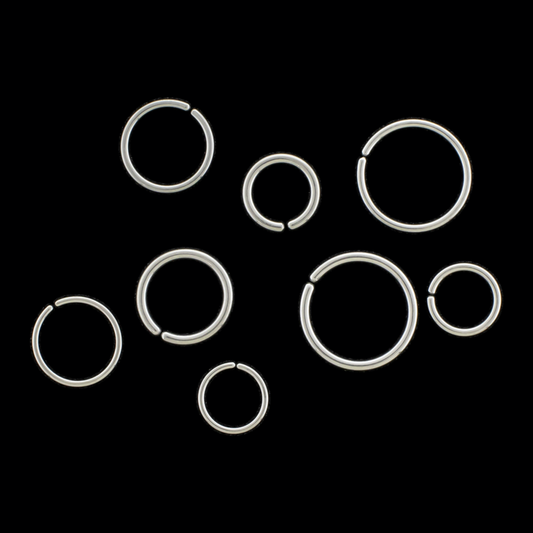
The Niobium Seamless Rings are a single continuous ring with a small gap between two flat ends. To insert the ring, the wearer or piercer gently separates the two ends by hand, threads the ring through the piercing, and pinches the ends back together. Because niobium is soft enough to open and close without tools, no pliers are required for most gauges.
This seamless niobium rings format produces the cleanest visual result of any ring style. With the gap closed, the ring reads as an uninterrupted circle with no visible closure hardware. This makes seamless niobium rings the most popular choice for nostrils, helix piercings, septum piercings, daith, and rook placements where a minimal look is the goal. Available in 14G through 20G.
Captive Bead Rings
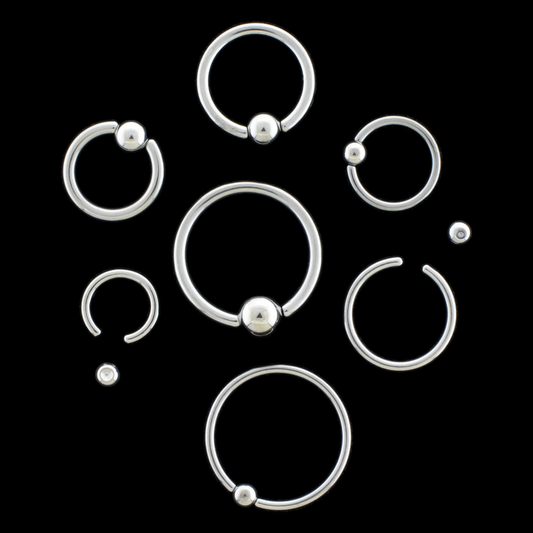
The Niobium Captive Bead Rings feature a ring with a gap at one point, held closed by a separate bead that sits under tension between the two ends. The bead can be removed to open the ring for insertion or removal, then replaced to close it. Captive beads at Khrysos are made from titanium for added strength at the contact point.
The captive bead format is slightly more visible than a seamless ring but allows for a decorative bead element. It is commonly used for septum piercings, daith, helix, and larger gauge placements where the bead adds visual interest. Available in 14G and 16G.
Fixed Bead Captive Rings
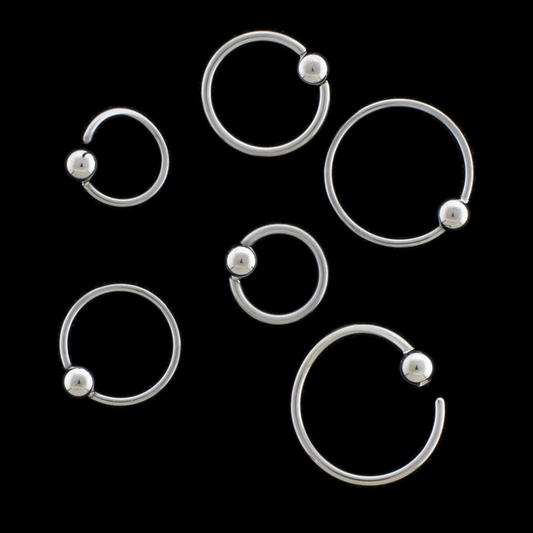
The Niobium 20G-16G Fixed Bead Captive Rings share the captive ring profile but with one key difference: the bead is permanently attached to one end of the ring rather than held under tension. Opening the ring separates the free end from the fixed bead end, making insertion and removal easier than a traditional captive configuration. This format is particularly practical for smaller gauge placements in the nostril, helix, and lobe where the bead is smaller and harder to handle under tension. Available in 20G through 16G.
Hinged Rings
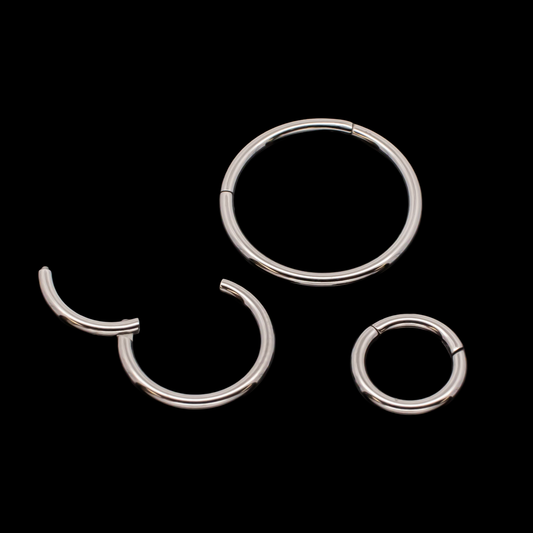
The Niobium Hinged Rings have a hinge point on one side and a snap closure on the opposite side. Opening the ring requires pressing or pulling the closure point; it then swings open on the hinge for easy insertion, then clicks shut. No bead to remove, no ring to bend. The hinged format is one of the easier ring styles to insert and remove independently, which makes it practical for self-serviced piercings in the septum, daith, helix, and nostril. Available in 14G and 16G.
Why Buy Niobium Rings at Khrysos
Khrysos sources industrial niobium rings and seamless styles from manufacturers who meet the APP material and quality standards that the piercing industry uses as its baseline, and every piece ships with the same day-of-order fulfillment that studio buyers and retail customers depend on.
- APP Phase 1 and 2 Verified: Khrysos meets the Association of Professional Piercers’ material and quality standards at both certification levels, a credential held by fewer than a hundred vendors globally.
- 99.9% Pure Niobium, No Alloys: Every niobium ring in this collection is pure element niobium with no alloy additions, making it the most reliably nickel-free option available.
- Anodized Colors Available - Biocompatible Oxide Layer, Never Coated: Anodizing produces color through a surface oxide reaction, not a coating. The color layer is inert and does not peel, flake, or introduce foreign material.
- ISO9001-Certified Manufacturing: Consistent production quality is documented and controlled under ISO9001 certification at every stage.
- Same-Day Shipping and Wholesale Access for Studios: Orders ship the same business day. Wholesale account pricing is available for professional piercing studios and buyers.
FAQ
Is niobium safe for a fresh piercing?
Pure niobium is APP-approved for body jewelry and is one of the most inert materials available. Its pure element composition, with no alloy metals or nickel content, makes it safe for healing piercings in most placements.
What is the difference between niobium and titanium for body jewelry?
Both are hypoallergenic and APP-approved. Niobium is a pure element at 99.9% purity; titanium body jewelry is an ASTM F-136 alloy. Niobium is softer, which makes it easier to open and close by hand for ring-format jewelry. Titanium is stronger and better suited for barbells and threaded pieces.
What is the difference between seamless, captive bead, fixed bead, and hinged niobium rings?
Seamless rings are a single continuous ring with a small gap closed by hand. Captive bead rings use a separate removable bead to close the gap. Fixed bead captive rings have the bead attached to one end. Hinged rings open on a hinge and click shut without a bead.
Can I open and close a niobium ring by hand?
Yes, for most gauges. Niobium is soft enough to bend by hand without tools, which is one of its main practical advantages over titanium rings at the same gauge. Larger gauges may benefit from gentle use of ring pliers.
Are anodized niobium rings safe for sensitive skin?
Yes. Anodizing niobium produces a color through an oxide surface reaction, not a coating. The anodized layer is inert, does not flake or peel, and introduces no additional material to the surface, making it safe for sensitive skin and healing piercings.
What gauge niobium ring do I need for my piercing?
Most nostril, helix, tragus, and cartilage piercings are 16G or 18G. Septum piercings are commonly 16G or 14G. Daith and rook piercings are typically 16G. Match the gauge already in your piercing for a direct replacement. Your piercer confirms the correct gauge for any new placement.
Does Khrysos offer wholesale niobium rings for piercing studios?
Yes. Khrysos offers wholesale account access and pricing for professional piercing studios. Create a wholesale account on the website or contact Khrysos directly to access studio pricing and bulk ordering.
Niobium rings deliver the most reliably pure hypoallergenic ring-format option for body piercing, and the four formats at Khrysos cover every common ring placement from nostril to daith to septum. Browse the styles above and contact the Khrysos team with any sizing, compatibility, or wholesale questions.