
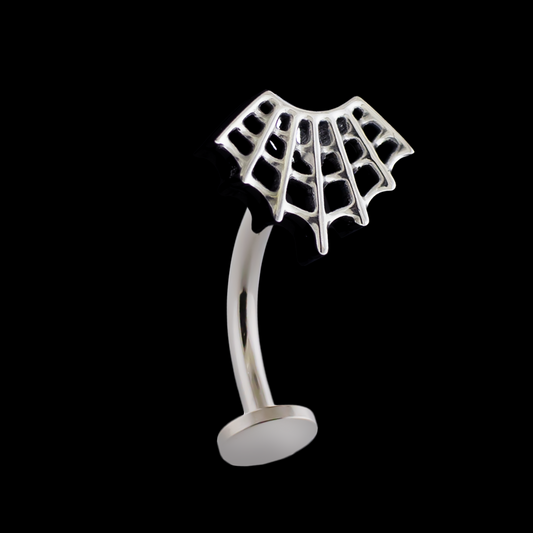
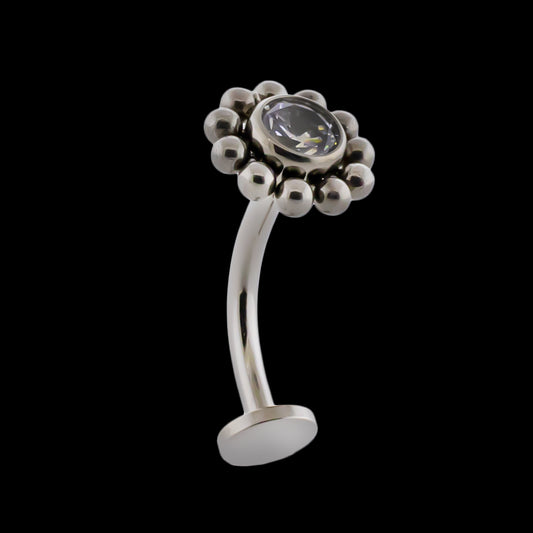
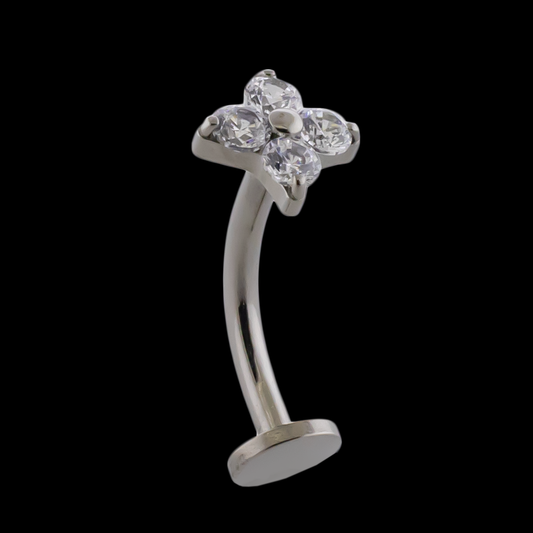
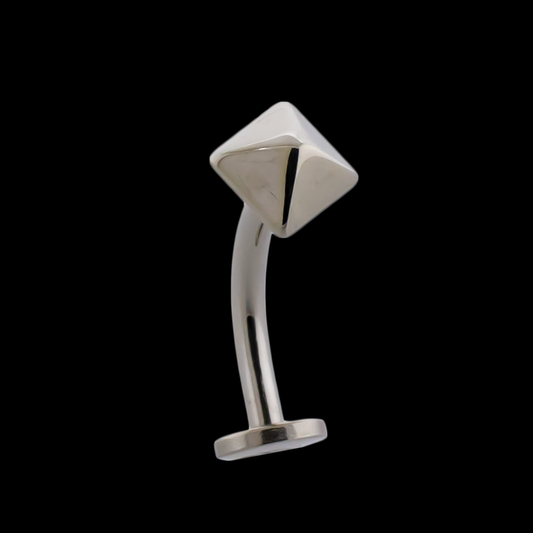
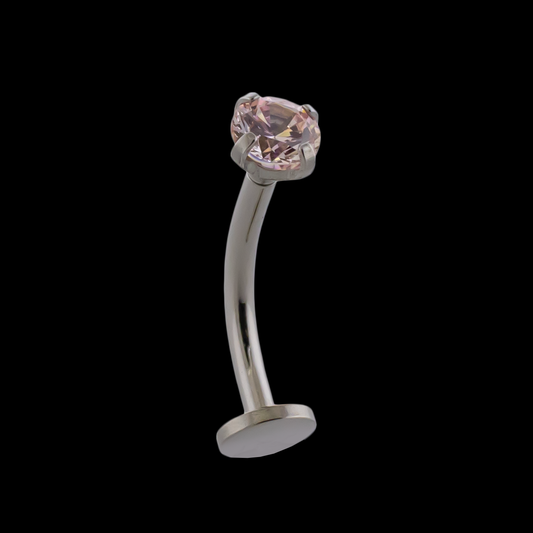
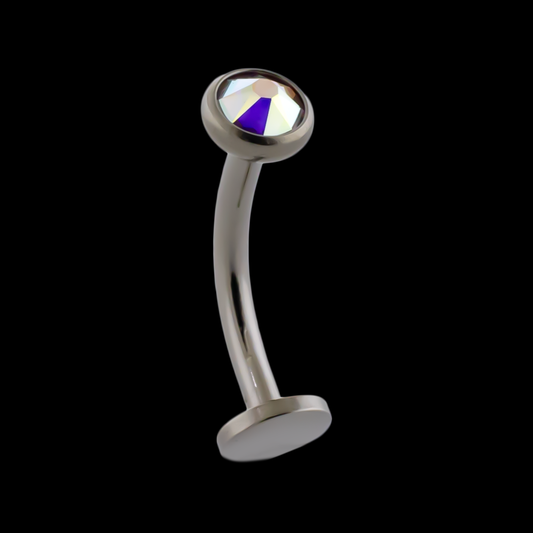
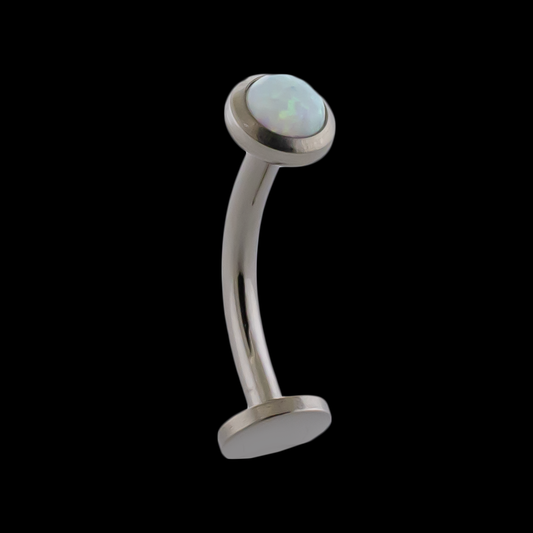
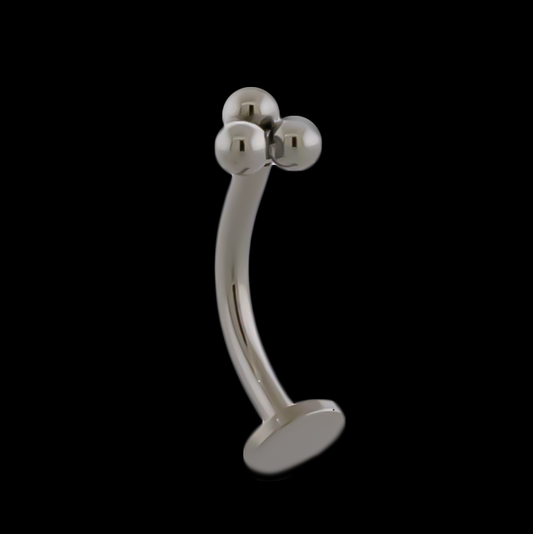
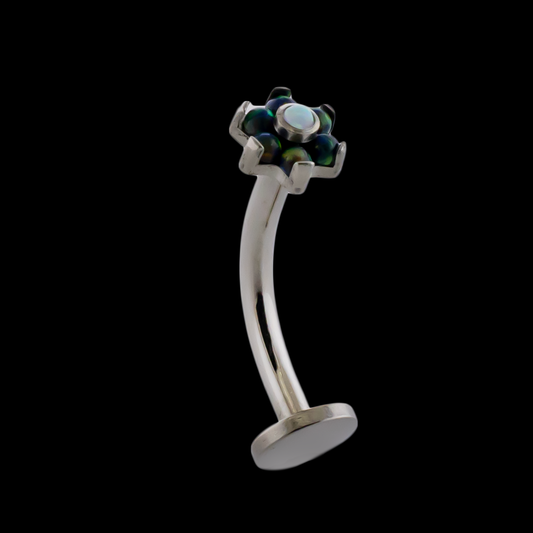
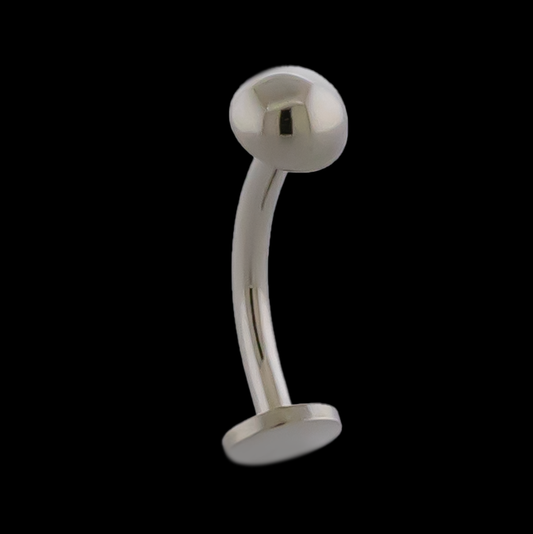
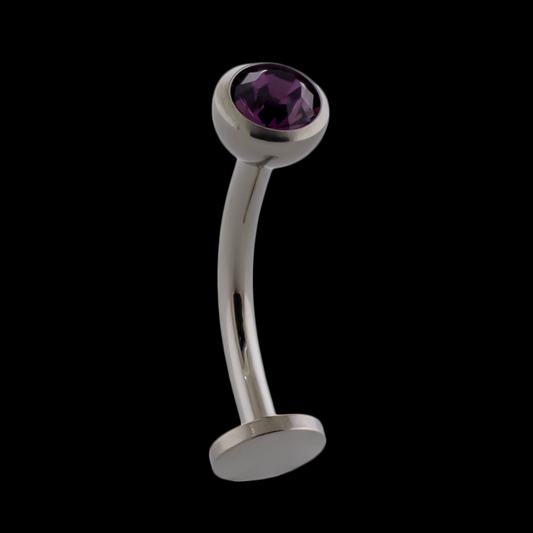
Jewelry for Ashley piercing is limited to one safe format: the flat-back labret stud. This piercing runs through the center of the lower lip, with the jewelry back sitting inside the mouth against the teeth and gums, which rules out curved barbells and rings. Every stud here is ASTM F-136 titanium, APP Phase 1 and 2 verified, in the standard 16G. Browse below.
What Is an Ashley Piercing
An Ashley piercing, sometimes searched as a lip piercing Ashley style, is a vertical piercing that passes through the center of the lower lip, with one end visible on the outside of the lip and the other end resting inside the mouth, typically against the back of the lower front teeth or the gumline. This single external point is what defines the piercing and separates it clearly from other lip piercing styles that share a similar look.
Because this piercing has only one visible point on the outside and a hidden point inside the mouth, the jewelry it uses has to be built around that constraint rather than general lip piercing conventions.
Ashley vs Vertical Labret: Why the Jewelry Must Be Different
This piercing is often confused with a vertical labret piercing, and the two do look similar from the front. The distinction matters because it determines which jewelry is safe to wear, and getting this wrong is the most common mistake people make when shopping for the right jewelry.
- Ashley: has one piercing point, with the back of the jewelry sitting inside the mouth against the teeth and gums, which is why only a flat-back labret stud is appropriate
- Vertical labret piercing: has two piercing points, both exiting through the skin of the lip and chin, with neither end entering the mouth, which is why a curved barbell works safely for this piercing
A vertical labret can safely wear a curved barbell because no part of the jewelry ever touches the inside of the mouth, which is the key anatomical difference buyers need to understand. This piercing cannot, because the rounded back of a curved barbell or a ring would sit directly against the teeth and gumline with every movement of the mouth.
Why Flat-Back Labret Studs Are the Only Safe Option
Any part of jewelry that is not flat, including a ball end, a curved bar, or a ring, creates a raised surface that presses repeatedly against the same spot inside the mouth. Over months and years of talking, eating, and sleeping, that repeated contact against the back of the lower teeth or the gumline can wear down tooth enamel or contribute to gum recession.
A flat-back labret stud solves this with a thin, flat disc instead of a rounded back. The disc distributes contact across a wider, flatter surface rather than concentrating pressure at a single rounded point, which is why flat-back labret studs are the only jewelry style considered appropriate for a piercing with an internal contact point like this one.
Signs You May Be Wearing the Wrong Jewelry
If you already have this piercing and were fitted with the wrong jewelry, such as a curved barbell or a ring rather than a flat-back stud, it is worth paying attention to how your mouth feels rather than assuming the discomfort is normal. A piercing in the wrong format does not always announce itself immediately, but the signs tend to show up with enough time.
- Gum irritation at a fixed spot: redness, soreness, or a receding gumline that always appears in the same place the jewelry rests
- Tooth sensitivity near the piercing: sensitivity or a rough feeling on the inside of a specific tooth that was not there before the piercing
- Visible wear on the tooth surface: a small flat or worn patch on the enamel exactly where the jewelry makes contact
None of these signs appear overnight, and early gum recession in particular can be easy to dismiss as general sensitivity. If you notice any of them, switching to a flat-back stud and mentioning it at your next dental checkup is a reasonable step, since a dentist can assess whether any damage has already occurred. Jewelry format is something you can correct immediately. Enamel wear and gum recession are not always reversible once they happen, which is the main reason to address the mismatch as soon as you notice it rather than waiting.
How Long an Ashley Piercing Takes to Heal
Healing time for an Ashley piercing is one of the most inconsistent numbers across piercing guides, largely because people conflate the point where swelling resolves with the point where the piercing is fully healed internally, and those are not the same milestone.
Swelling from the initial piercing typically resolves within six to eight weeks, which is when most piercers will downsize the jewelry to a shorter post. This downsizing step addresses comfort and fit, not full healing. Internally, the piercing channel usually continues to stabilize for two to four months total, and because this piercing sits in the mouth where saliva, eating, and talking all place ongoing demands on the healing tissue, some people find it takes longer to feel fully settled than a comparable piercing on skin. Individual healing speed, oral hygiene, and how well the piercing is cared for during the first few weeks all affect this timeline. If your piercing still feels tender, swollen, or irritated well past two months, checking in with your piercer is a better next step than assuming something is wrong.
Choosing Gauge and Length
Getting gauge and length right matters more here than for most other piercings, because the internal disc sits against sensitive oral tissue rather than skin.
- Gauge: 16G is the standard gauge for this piercing, and this collection is built around that size
- Initial length: the first stud fitted by your piercer is intentionally longer than your final jewelry, to leave room for the swelling that follows the piercing
- Healed length: once swelling has fully resolved, typically within six to eight weeks, a shorter stud that sits closer to the lip is the better long-term fit
Because the internal disc sits against oral tissue, having your piercer confirm and fit the downsized length is the safer approach rather than guessing at a shorter size yourself.
Why Titanium Matters for Oral Piercing Jewelry
The internal end of this piercing sits in an environment unlike any piercing on skin. It is in constant contact with saliva, oral bacteria, and the enzymes naturally present in the mouth, all of which create more opportunity for a reactive or lower-grade metal to corrode over time than exposure to air and skin would.
ASTM F-136 titanium is biologically inert and does not corrode or break down in this environment, which is why it is the material recommended for jewelry with any part sitting inside the mouth. A lower-grade metal exposed to saliva daily is more likely to degrade and introduce metal particles into oral tissue than the same metal would on an external piercing.
Material quality addresses one side of oral piercing safety. The other side is routine dental care. Anyone wearing jewelry with a component inside the mouth long-term benefits from mentioning it at regular dental checkups, since a dentist can monitor the contact point for early wear that may not be obvious day to day.
Why Buy Your Ashley Piercing Jewelry at Khrysos
Khrysos is APP Phase 1 and 2 verified, and every flat-back labret stud in this collection is produced at an ISO9001-certified facility to APP material and dimension standards.
- APP Phase 1 and 2 Verified: Every stud meets the material, dimension, and finishing standards required for use in APP-affiliated studios
- ASTM F-136 Titanium with Mill Certificate: Each batch is backed by documentation verifying true implant-grade composition
- ISO9001-Certified Manufacturing: Consistent quality control across disc thickness, post length, and surface finish
- Flat-Back Design Built for Oral Safety: Every stud uses a flat disc rather than a rounded back, the only format appropriate for internal oral contact
- Same-Day Shipping and Wholesale Access: Orders within the cutoff window ship the same day, and wholesale accounts are available for professional piercers
Once this piercing is fully healed, the Titanium Internally Threaded Labrets collection offers additional flat-back styles with interchangeable decorative ends.
For wearers ready to upgrade to solid gold, the 14KT Gold Labrets collection carries the same flat-back format in 14-karat gold.
Conclusion
The jewelry choice here is defined by one rule: anything that is not a flat-back labret stud risks contact with your teeth and gums every day you wear it. Getting the gauge, length, and material right protects both the piercing and your oral health. With ASTM F-136 titanium and APP-verified manufacturing, Khrysos gives your piercing the safest practical foundation.