
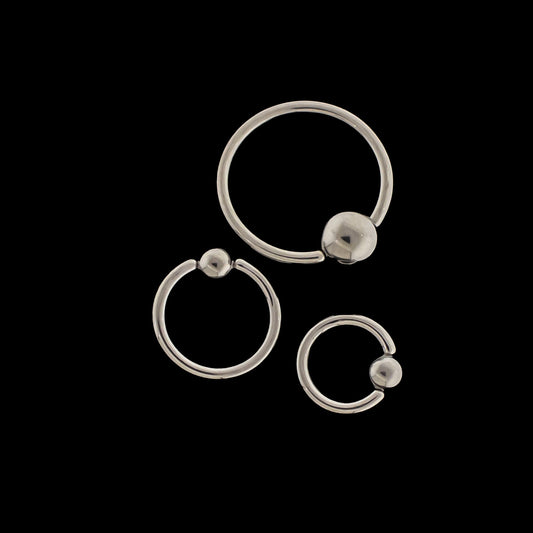

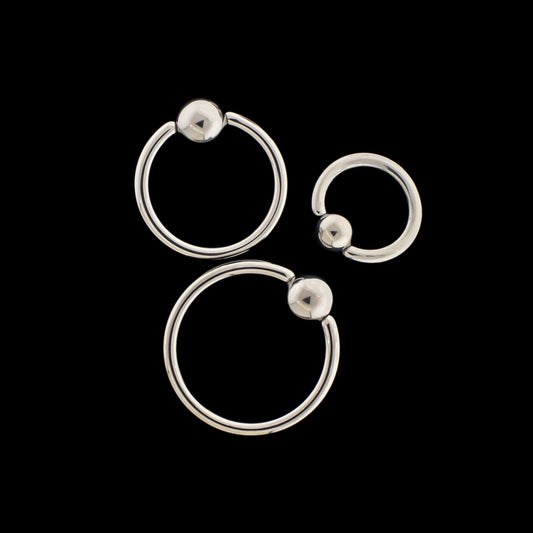
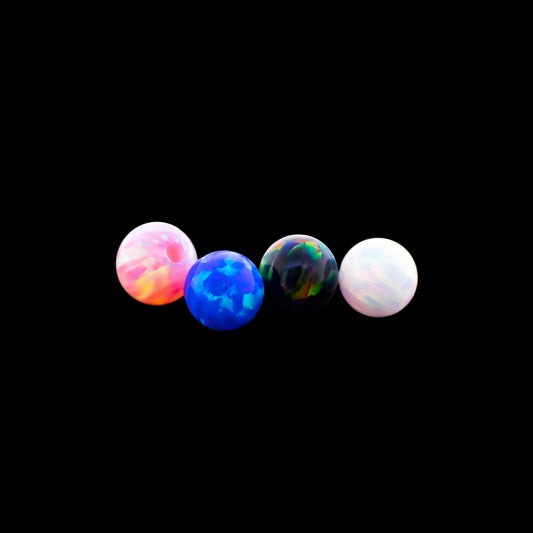
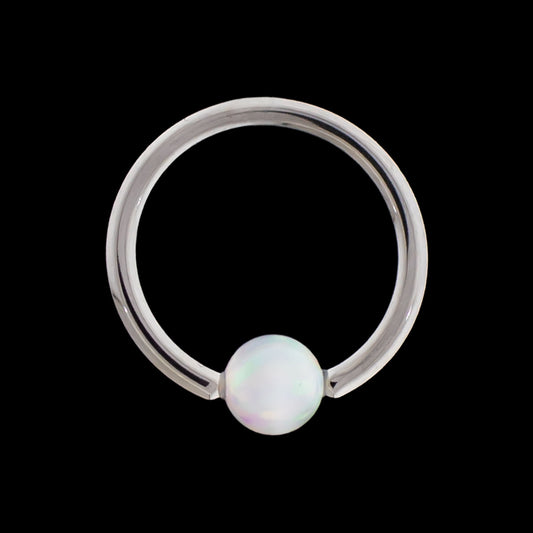
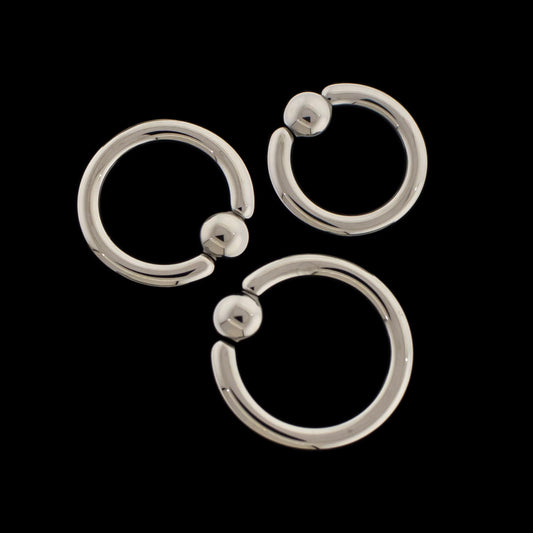
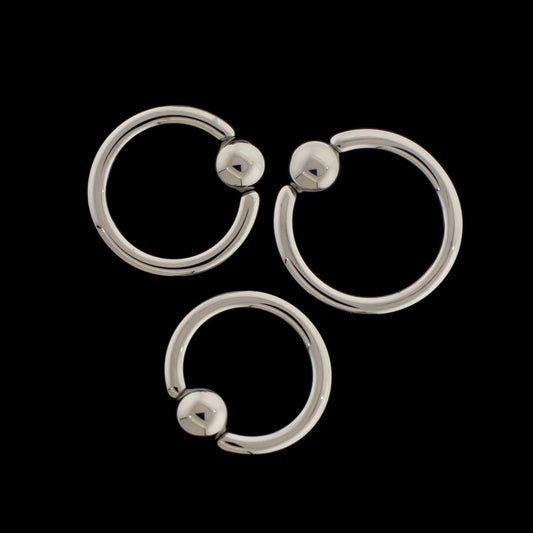


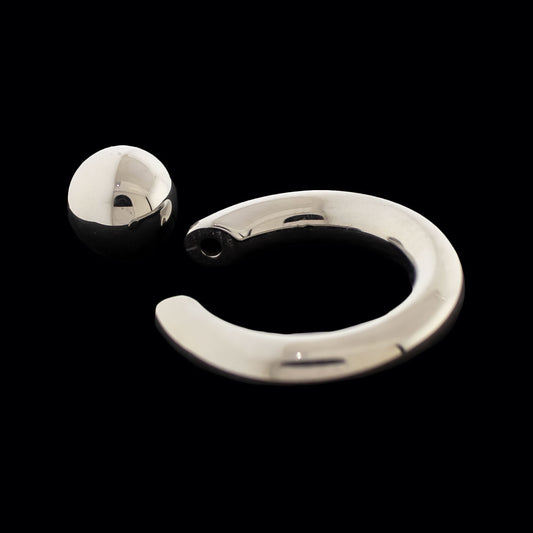

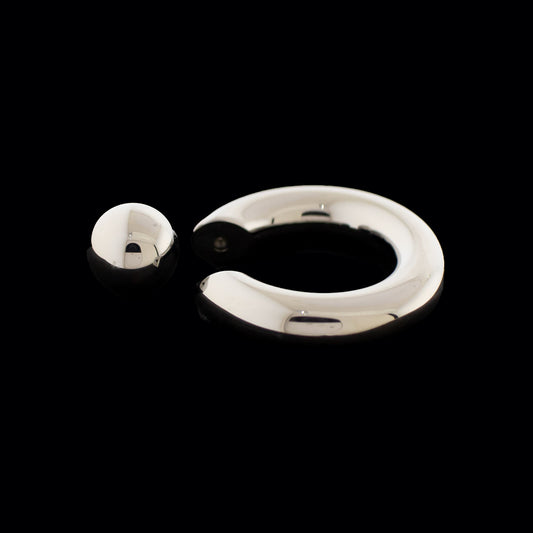
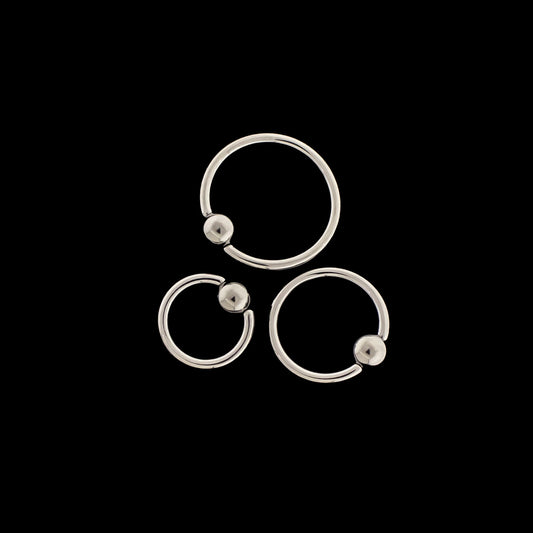

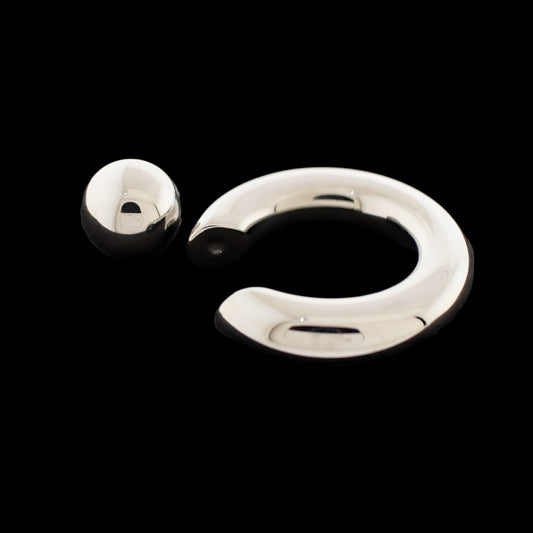
Captive bead ring jewelry in ASTM F-136 implant-grade titanium gives healed septum, ear, and nipple piercings a classic, secure closure. Every ring in this collection is held shut by a bead and the tension of the ring, from fine 18G styles up to heavy 2G sizes, with snap bead technology on the larger gauges. Khrysos is APP Phase 1 and 2 verified. Browse sizes and bead options below.
What Is a Titanium Captive Bead Ring
A captive bead ring, often shortened to CBR or ball closure ring, is one of the most familiar hoops in body jewelry. Its design is simple, and understanding it makes every sizing and care decision easier.
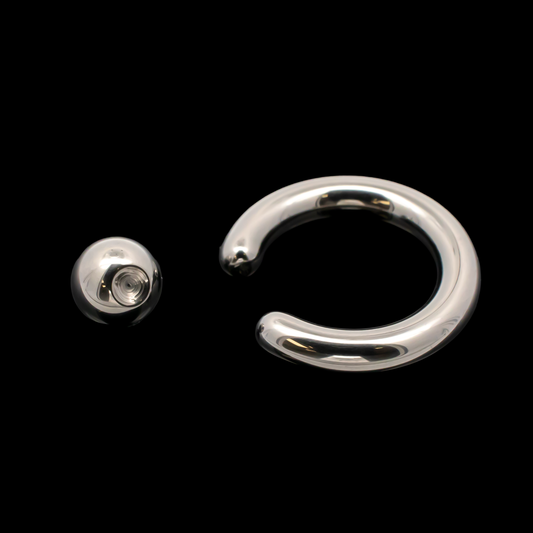
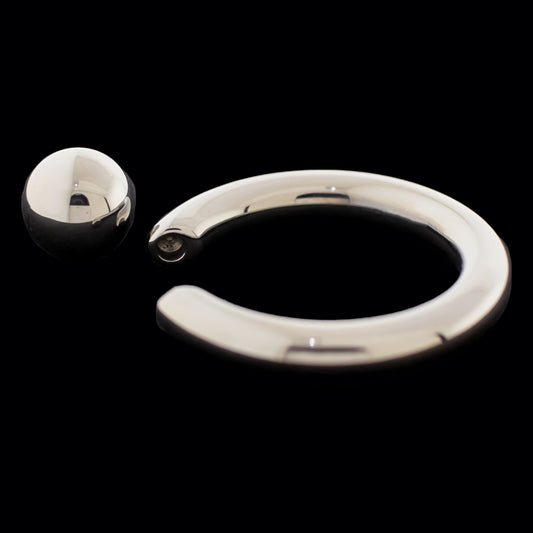
The ring has a small gap, and a bead slightly larger than that gap sits in it, held in place by the tension of the ring ends pressing on the bead. You may also see it searched as a bead captive ring, but the design is the same. Spread the ring ends slightly, release the bead, and the ring comes free of the piercing. Titanium suits this design because it is light and strong, so the ring keeps its spring and the bead stays secure.
CBRs sit within a wider family of ring formats:
- CBR: the bead is a separate piece held by ring tension, so it can be removed completely
- Fixed bead ring: the bead is attached to one side of the ring, as in the Khrysos niobium fixed bead rings with a titanium bead, so there is no loose bead to lose
- Hinged segment ring: one arc opens on a hinge and clicks shut, with no bead and no bending
- Seamless ring: a continuous circle that must be bent open and closed
If a ring that closes with a click suits you better than a bead, browse the Titanium Hinged Rings collection.
How to Open and Close Your Captive Bead Ring
Whether a captive bead ring needs tools depends mostly on its gauge, and that is the detail many shoppers want answered before buying. Here is how it breaks down:
- Fine gauges (18G and 16G): many wearers learn to open and close the ring by hand with some practice, and a ball grabber or ring-opening pliers can make it easier
- Mid gauges (10G): the ring is stiffer, so ring-opening pliers are often the easiest way to open and close it
- Heavy gauges (8G, 6G, 4G, and 2G): Khrysos builds these with snap bead technology, where a small hole drilled in the end of the ring lets the bead slide in and out with no tools needed
Whichever gauge you wear, open the ring only as far as needed to release the bead. A ring that is spread too wide loses the tension that holds the bead secure.
Choosing Gauge, Diameter, and Bead Size
Three measurements decide whether a ring fits and feels right: gauge, inner diameter, and bead size. Gauge must match your piercing, while diameter and bead size shape how the ring sits and looks. The Khrysos range runs as follows, with diameters converted to approximate millimeters:
- 18G: 1/4" to 3/8" (about 6mm to 10mm) with a 3mm bead
- 16G: 1/4" to 9/16" (about 6mm to 14mm), with a 3mm bead on the smaller sizes, a 5mm bead at 1/2", and a 4mm bead at 9/16"
- 10G: 3/8" to 1/2" (about 10mm to 12mm) with a 5mm bead
- 8G: 1/2" to 5/8" (about 12mm to 16mm) with a 6mm bead
- 6G and 4G: 1/2" to 5/8" (about 12mm to 16mm) with an 8mm bead
- 2G: 1/2" to 5/8" (about 12mm to 16mm)
If you are replacing an existing ring, matching its gauge and diameter is the most reliable approach. A larger diameter hangs lower and moves more, while a smaller one sits closer to the tissue, so ask your piercer which suits your anatomy if you are unsure.
Titanium vs Niobium vs Steel for Captive Bead Rings
Material changes how captive bead ring jewelry feels, how it opens, and how it behaves against sensitive skin. Each of the three common choices has a clear role.
ASTM F-136 titanium is light, strong, nickel-free, and the standard that APP-affiliated studios rely on. Its strength means the ring holds its tension well, though at heavier gauges it is stiffer to open without a tool. All Khrysos titanium is covered by a lifetime guarantee on workmanship and is fully autoclavable.
Niobium is softer and more flexible, which makes ring closures more forgiving and easier to open by hand, and it is also naturally nickel-free. If hand-opening matters most to you, the Niobium Rings collection is worth a look.
Surgical stainless steel is common in budget CBRs but contains nickel, which can irritate wearers who react to it. For continuous wear in a healed piercing, titanium or niobium is the safer material choice.
Captive Bead Rings in Fresh vs Healed Piercings
Captive bead ring piercing jewelry is widely worn, but the right moment to wear it depends on the stage of your piercing.
In a healed piercing, a titanium captive bead ring is a comfortable, long-term choice at almost any ring placement. In a fresh piercing, the picture is less clear. Some piercers install rings in new piercings, while others prefer barbells for certain placements, because the circular shape can drag dried lymph back toward a healing piercing and swelling needs room. Anatomy and placement vary, so follow the guidance of the professional who pierced you, and switch to a ring once your piercer confirms the piercing has healed.
Where to Wear Your Titanium Captive Bead Ring
Captive bead ring piercing jewelry suits any healed placement where a hoop is appropriate, and gauge is what changes from one location to the next. The circular profile of a CBR reads differently at each placement, from a subtle hoop in a fine helix to a bold statement ring in a conch or a nipple piercing.
Septum piercings are the most common home for a CBR. The circular shape lets the ring hang symmetrically below the columella, and fine to mid gauges give you a range from a delicate close-fit ring up to a more prominent style. For a click-closed alternative without a separate bead, see the Titanium Septum Clickers collection.
Helix and daith piercings suit fine gauges, typically 18G or 16G, with a smaller inner diameter of 6mm to 10mm depending on the anatomy. A CBR at the helix reads as a hoop earring from the front, making it a popular choice for wearers who prefer rings over studs in their cartilage stack. Daith piercings need a ring large enough to seat inside the crus of the helix, typically 8mm to 10mm, so the ring sits freely rather than pressing into the surrounding cartilage.
Conch piercings require a wider diameter than most ear placements because the bowl of the conch is larger than the outer ear ridge. A 10mm to 12mm ring in 16G fits most standard conch piercings. The Conch Rings collection focuses specifically on rings sized and styled for that placement.
Nipple piercings are a classic CBR format, and the symmetrical hoop sits naturally at this placement without the same risk of catching on clothing that asymmetric designs can have. The Titanium Nipple Jewelry collection offers additional styles for this placement. Heavy gauges from 10G to 2G also suit stretched lobes and larger septum piercings where a snap bead makes bead changes easier and avoids the need to use ring-opening pliers on very stiff rings.
Why Buy Your Titanium Captive Bead Rings at Khrysos
Khrysos is APP Phase 1 and 2 verified, and every captive bead ring in this collection is produced at an ISO9001-certified facility to APP material and dimension standards.
- APP Phase 1 and 2 Verified: Every ring meets the material, dimension, and finishing standards required for use in APP-affiliated studios
- ISO9001-Certified Manufacturing: Consistent quality control across ring tension, bead fit, and surface finish
- ASTM F-136 Implant-Grade Titanium: Nickel-free and non-reactive, polished to a high shine, with a lifetime guarantee on workmanship
- Snap Bead Technology on Heavy Gauges: 8G, 6G, 4G, and 2G rings open and close with no tools needed
- Same-Day Shipping and Wholesale Access: Orders within the cutoff window ship the same day, and wholesale accounts are available for professional piercers
FAQ
What is a titanium captive bead ring?
A bead captive ring, more commonly called a CBR, is a hoop with a small gap closed by a bead that the ring tension holds in place. The Khrysos versions are made from ASTM F-136 implant-grade titanium and polished to a high shine.
Do I need tools to open a captive bead ring?
Fine gauges can often be opened by hand with practice, while mid gauges are easier with ring-opening pliers. Khrysos 8G, 6G, 4G, and 2G rings use snap bead technology and need no tools.
What gauge and diameter should I choose?
Match the gauge of your current jewelry, then choose a diameter that sits the way you prefer, from about 6mm at 18G up to about 16mm at heavier gauges. Your piercer can confirm the best fit if you are unsure.
Can I wear a captive bead ring in a fresh piercing?
Some piercers use rings in new piercings, but many prefer barbells for certain placements while swelling settles. Follow your piercer's advice and switch once the piercing is healed.
What is the difference between a captive bead ring and a hinged ring?
A CBR closes with a separate bead held by ring tension, while a hinged ring has an arc that opens on a hinge and clicks shut. The hinged style needs no bead or bending.
Titanium or niobium for a captive bead ring?
Titanium is lighter and stronger, while niobium is softer and easier to open by hand. Both are nickel-free, so the choice comes down to how you want the ring to feel and open.
Do Khrysos titanium rings have a guarantee?
Khrysos offers a lifetime guarantee on the workmanship of its ASTM F-136 titanium. If a manufacturing defect occurs, contact the team and the piece is replaced once the original is returned.
Conclusion
Choosing the right captive bead ring comes down to gauge, diameter, bead size, and how you prefer to open and close it. With ASTM F-136 titanium, snap bead styles for heavy gauges, and APP-verified manufacturing, Khrysos makes each decision straightforward. Pair the right size with advice from your piercer, and the best captive bead ring piercing jewelry will wear comfortably for years.