


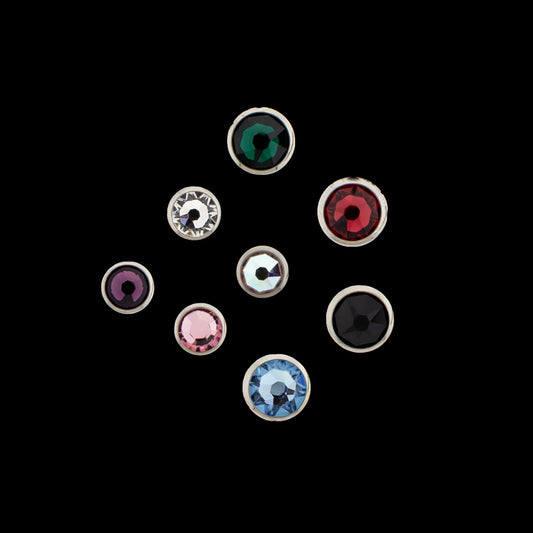
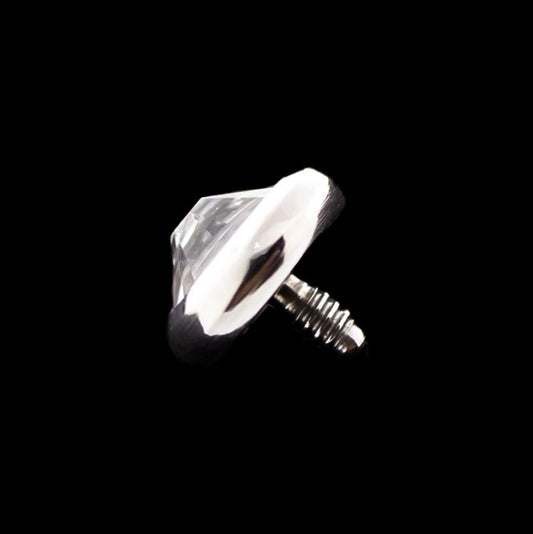


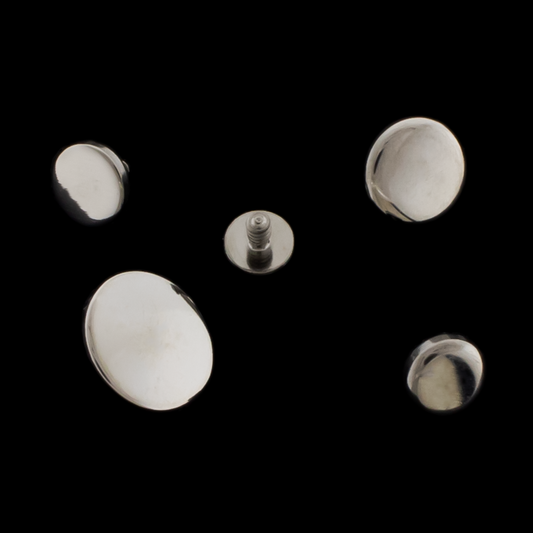
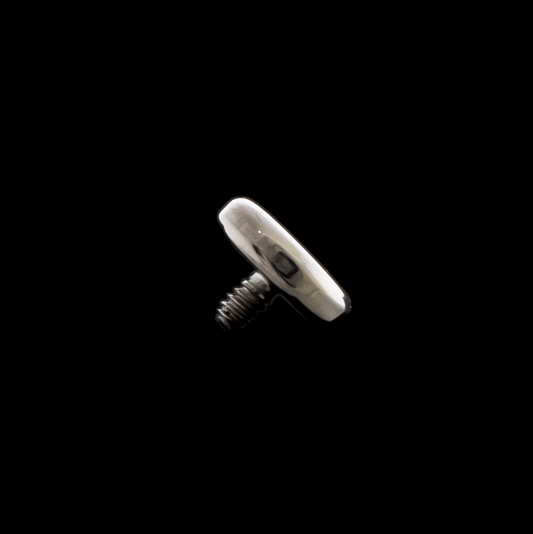


Surface piercing jewelry, sometimes spelled surface piercing jewellery, is engineered for flat areas of the body such as the nape, collarbone, hip, chest, and anti-eyebrow, where standard barbells are not designed to sit. This collection covers both surface bars and dermal anchors in ASTM F-136 implant-grade titanium, built to reduce pressure on the surrounding tissue. Khrysos is APP Phase 1 and 2 verified. Browse bars, anchors, and tops below.
What Makes Surface Piercing Jewelry Different
A surface piercing runs horizontally beneath the skin rather than through a protruding part of the body like an earlobe. That single difference changes everything about how the jewelry needs to behave, and it is the reason surface piercing jewelry exists as its own category rather than overlapping with standard barbells.
Because the jewelry passes under flat skin instead of through tissue with natural give, it creates two points of contact with the body rather than one. The body can read a piece sitting this way as something to push toward the surface and out, a process piercers call migration when it is gradual and rejection when the jewelry fully exits. Specialized surface piercing jewelry, with flat bars and angled ends, is designed specifically to reduce the pressure that drives that process, though no jewelry can fully eliminate the risk.
Surface Bar vs Dermal Anchor: Know the Difference
Both of these fall under "surface piercing jewelry," but they are built on entirely different mechanisms, and knowing which one your piercing uses is essential before you order a replacement part.
- Surface bar: uses two piercing points, an entry and an exit, connected by a bar that runs horizontally beneath the skin; each end bends at roughly 90 degrees and holds a decorative top that screws on separately
- Dermal anchor: uses a single piercing point, with a small base or foot inserted beneath the dermis and only one decorative top visible at the surface
A surface bar needs two healthy points of tissue to anchor into, which is why placement and spacing matter more for this format. A dermal anchor needs only one point, which is part of why it is often chosen for placements where a straight bar would not fit, such as a flat chest piece or a small facial dot. For a dermal setup, the 14g Titanium Dermal Anchor with 3-Hole Base uses a perforated foot that allows tissue to grow through it for a more secure hold.
For a surface bar setup, the Titanium Internally Threaded Flat Surface Barbell is sold as the bar only, with tops purchased separately.
Why Flat Design and Titanium Reduce Rejection
A standard round barbell concentrates force at a small point of contact wherever it meets tissue, which is why every Titanium Internally Threaded Flat Surface Barbell in this collection is machined flat instead of round. Under a flat area of skin with no give to distribute that pressure, a round bar is more likely to be read by the body as something to push out. A flat bar spreads that same mechanical load across a wider surface area, lowering the pressure at any single point and giving the surrounding tissue more room to settle around the jewelry rather than against it.
Material plays a second role alongside shape. ASTM F-136 titanium is biologically inert, which means it does not corrode or provoke an ongoing inflammatory response the way lower-grade metals can. Chronic low-level inflammation is one of the factors that raises rejection risk over time, so a stable, non-reactive material gives the tissue the best chance to adapt to a shape that is already working against it less than a round bar would.
It is worth watching for early signs that a surface piece is struggling:
- Jewelry sitting higher: the bar or anchor appears to be migrating closer to the surface than when it was first placed
- Thinning or shiny skin: the tissue directly over the bar looks stretched, pale, or unusually thin
- Persistent redness: irritation that does not settle down once the initial healing period has passed
None of these signs mean the piercing will definitely fail, but they are worth a check-in with your piercer sooner rather than later.
The Two-Stage Jewelry Process for Surface Piercings
Most surface piercings are not fitted with their final jewelry on day one. The initial bar is intentionally longer than the piece you will wear once healed, because the piercing needs room to accommodate swelling in the first weeks.
Once that swelling has fully resolved, which can take anywhere from a few months to well over a year depending on placement and individual healing, a piercer swaps the initial bar for a shorter one that sits closer to the skin. This reduces movement, lowers the chance of the jewelry catching on clothing, and tends to look cleaner once the piercing has settled. Changing a surface bar or dermal anchor is not a task to do on your own. The angled ends and the depth of insertion make professional removal and reinsertion the safer route at both stages.
Where Surface Piercings Are Most Likely to Succeed
Not every flat area of the body carries the same odds of long-term success, and this is worth knowing honestly before you commit to a placement, jewelry choice aside.
Placement plays a real role in long-term stability:
- Lower movement areas, such as the nape or hip: tend to settle more predictably, with less daily friction from clothing or constant flexing
- High movement or high friction areas, such as the collarbone or sternum: carry a higher baseline risk, since straps, waistbands, and constant flexing increase mechanical stress
This is not a guarantee in either direction. Individual anatomy, skin thickness, and how the piercing was placed all matter as much as location. The honest takeaway is that a consultation with an experienced piercer who can assess your specific anatomy before the piercing happens is the single best predictor of a surface piercing that lasts, more so than any jewelry choice made afterward.
Choosing Gauge and Length
Getting the right gauge and length matters more for piercing surface jewelry than for most other piercings, because an ill-fitting bar increases the exact pressure this jewelry is designed to avoid.
14G is the most common gauge for surface bars and dermal anchors, and this collection also carries 12G and 10G for larger placements. Length depends on the thickness of tissue at the piercing site. A nape piercing typically sits over thicker tissue than an anti-eyebrow piercing, so the two placements rarely use the same bar length even at the same gauge. Tops generally thread onto a standard internal fitting, commonly 0.9mm for 18G and 16G ends or a 14G fitting depending on the specific base, so checking the threading on both the bar and the top before ordering them separately is the best way to avoid a mismatch.
Mixing and Matching Bars and Tops
Most of the pieces in this collection are sold as separate components rather than complete assembled jewelry, which means you choose a bar or anchor base first and then select the decorative top that threads onto it.
This surface piercing jewelry collection includes a range of tops suited to different styles, from the bezel-set Marlowe: 14G Internally Threaded Bezel Set Crystal Disc for a clean, low-profile look, to gem flower and prong-set zirconia designs for a more decorative finish. Because tops and bases share the same threading standard within a given gauge, you can change the decorative top on a healed piercing without replacing the base underneath it, as long as the threading matches.
Why Buy Your Surface Piercing Jewelry at Khrysos
Khrysos is APP Phase 1 and 2 verified, and every piece of surface piercing jewelry in this collection is produced at an ISO9001-certified facility to APP material and dimension standards.
- APP Phase 1 and 2 Verified: Every piece meets the material, dimension, and finishing standards required for use in APP-affiliated studios
- ASTM F-136 Titanium with Mill Certificate: Each batch is backed by documentation verifying true implant-grade composition, not just a marketing label
- ISO9001-Certified Manufacturing: Consistent quality control across threading tolerances, bend angles, and surface finish
- Flat Bar Design to Minimize Pressure Points: Surface bars are engineered to distribute mechanical load more evenly than a round barbell
- Same-Day Shipping and Wholesale Access: Orders within the cutoff window ship the same day, and wholesale accounts are available for professional piercers
Conclusion
Surface piercing jewelry exists because flat placements behave differently from standard piercings, and the right bar, anchor, and gauge can meaningfully reduce the pressure that leads to migration. Understanding whether your piercing uses a surface bar or a dermal anchor, and sizing it correctly, matters as much as the material it is made from. With ASTM F-136 titanium and APP-verified manufacturing, Khrysos gives your surface piercing the strongest practical foundation.