


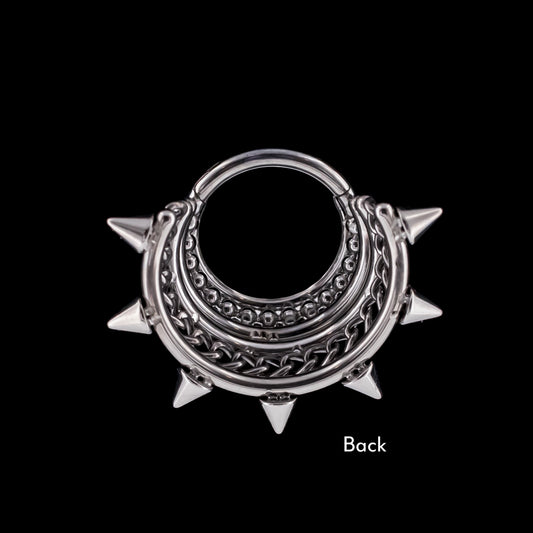


Titanium hinged segment ring designs give healed septum, daith, and cartilage piercings a secure, tool-free closure in ASTM F-136 implant-grade titanium. Every ring in this collection opens on a small hinge and clicks shut, in plain polished and gemstone-set styles. Khrysos is APP Phase 1 and 2 verified and backs its titanium with a lifetime workmanship guarantee. Browse styles and sizes below.
How a Titanium Hinged Segment Ring Works
A titanium hinged segment ring opens and closes without tools, which is what sets it apart from the other common ring formats. Knowing how the mechanism works makes it easier to choose the right style for your piercing.
One small arc of the ring is joined to the rest by a hinge. Press that segment open, slide the ring through the piercing, then press it back until it clicks closed. When shut, the segment sits flush with the ring, leaving a continuous hoop with no gap to catch hair or clothing. Here is how the three common formats compare:
- Captive bead ring: holds a loose bead by tension between the ring ends, so it needs bending or a tool to open, and the bead can slip out if it is not seated firmly
- Seamless ring: a continuous circle that must be bent open by hand or with pliers, which can distort the metal over repeated changes
- Titanium hinged segment ring: opens on its own hinge and clicks shut, with no bead to lose and no bending of the ring
This difference matters most for placements you change often. Many septum wearers flip the ring up during the day and back down later, and a hinged ring makes that a one-handed adjustment. If you prefer the traditional bead look, browse the Titanium Captive Bead Rings collection.
Why Titanium for a Hinged Ring
Material matters more in a ring than in most jewelry because it stays in the piercing around the clock. ASTM F-136 titanium is the standard that APP-affiliated studios rely on for body jewelry.
Implant-grade titanium is nickel-free, non-reactive, and does not corrode in contact with skin, which makes it a dependable choice for wearers who react to steel or costume metals. It is also lightweight, which suits a hinged design, since a ring with moving parts feels more comfortable when the metal is light, especially in cartilage that carries several pieces at once. All Khrysos titanium is fully autoclavable, though you should check your autoclave manual for settings.
Because cartilage piercings require long healing timelines, sometimes six to twelve months for full tissue stability, the material you choose at the initial healing stage matters. ASTM F-136 titanium is the default specification for initial jewelry at APP-affiliated studios worldwide, not because of convention but because its low reactivity and surface stability are well-documented in body piercing literature. For healed placements, the same reasoning applies over a longer period.
One point worth knowing before you buy is that some titanium rings on the market get their gold or black color from a PVD coating applied over the titanium. The metal underneath is genuine titanium, but the color is a thin surface layer that can wear with friction and daily contact. The rings in this collection are crafted from ASTM F-136 titanium and finished by polishing, so what you see is the metal itself rather than a coating.
If you want the same click-closed design in real gold, the 18KT Gold Hinged Segment Rings collection offers it in solid 18K gold.
Khrysos also offers a lifetime guarantee on the workmanship of its ASTM F-136 titanium. If a piece has a manufacturing defect, contact the team and it will be replaced once the original piece is returned.
Choosing the Right Diameter and Gauge
Inner diameter decides whether a ring seats correctly, and gauge must match your existing piercing. The ranges below are typical starting points, and your piercer can confirm the best fit for your anatomy.
- Septum: typically 8mm to 10mm, depending on anatomy and how prominent you want the ring to sit
- Daith: typically 8mm to 10mm, so the ring can seat inside the crus of the helix
- Helix and other cartilage: typically 6mm to 8mm for a close, low-profile fit
- Conch: often 10mm to 12mm because of the larger area of tissue
Match the gauge to the jewelry you currently wear. 16G is common for septum and most cartilage, while 18G and 20G suit finer placements such as the nostril, and the Khrysos 20G hinged segment ring is offered in five sizes. These rings are designed for healed piercings, so if yours is still fresh, have your piercer choose the initial jewelry.
For septum-specific styles, the Titanium Septum Clickers collection is a good next stop.
Gemmed vs Non-Gemmed Hinged Rings
The collection covers two style directions, and the right one depends on whether the ring is a quiet base layer or the piece you want noticed.
Non-Gemmed Titanium Hinged Rings
Plain and sculptural rings let the metal do the work. Asimil has a hammered texture hand-polished to a mirror shine, Selune adds a crescent moon design, and Array packs five stacked rings into a single 16G hinged ring for a layered look without wearing five pieces. These suit wearers who want a quiet base layer or a textured accent.
Gemmed and Double-Hinged Styles
For sparkle, Cerise uses a gemmed double-hinged design in prong-set clear cubic zirconia or a mix of zirconia and white synthetic opals. Victoria sets baguette cubic zirconia with a slide-in click closure, and Desiree combines round and pear-cut premium zirconia in two sizes. These work well as the centerpiece among simpler rings.
Where to Wear Your Titanium Hinged Ring
This ring style works across most healed ear and nose placements, and the diameter and gauge you need change with each location. The hinged click-closed design matters most in placements that are difficult to reach from behind, because the ring can be opened from the front without needing to grip the back of the jewelry.
Septum piercings are the most common home for a titanium hinged ring. The hinge lets you flip the ring inside the nose during the day and back down when you want the jewelry visible, a practical feature that captive bead rings and seamless rings cannot match as easily. Most septum piercings use a diameter of 8mm to 10mm, depending on the anatomy of the columella.
Daith piercings require a slightly larger diameter than helix because the ring must seat inside the crus of the helix rather than simply passing through a straight channel. The ring needs space to sit inside that ridge without pressing against surrounding cartilage, so 8mm to 10mm in 16G suits most daith placements.
Helix and rook piercings typically use smaller diameters, usually 6mm to 8mm, so the ring sits close against the curve of the ear. A smaller diameter at the helix also makes stacking with adjacent rings cleaner, since each piece takes less lateral space. Conch piercings benefit from a larger diameter, often 10mm to 12mm, because the bowl of the conch is wider than the outer cartilage ridge. Nostril piercings use a finer gauge and a smaller diameter, typically 18G or 20G with a 6mm to 8mm inner diameter. For lobes, add a quantity of two to the cart if you want a matching pair.
Why Buy Your Titanium Hinged Ring at Khrysos
Khrysos is APP Phase 1 and 2 verified, and every titanium hinged segment ring in this collection is produced at an ISO9001-certified facility to APP material and dimension standards.
- APP Phase 1 and 2 Verified: Every ring meets the material, dimension, and finishing standards required for use in APP-affiliated studios
- ISO9001-Certified Manufacturing: Consistent quality control across hinge tolerances, diameter accuracy, and surface finish
- ASTM F-136 Implant-Grade Titanium: Nickel-free and non-reactive, with a polished finish that is the metal itself rather than a coating
- Lifetime Guarantee on Workmanship: Manufacturing defects are replaced once the original piece is returned
- Same-Day Shipping and Wholesale Access: Orders within the cutoff window ship the same day, and wholesale accounts are available for professional piercers
FAQ
What is a titanium hinged segment ring?
It is a hoop with one arc attached by a small hinge that opens to slide into a piercing and clicks shut. It needs no tools or bending and is made here from ASTM F-136 implant-grade titanium.
How is a hinged segment ring different from a captive bead ring?
A captive bead ring holds a loose bead by tension and usually needs bending or a tool to open. It opens on its own hinge and clicks closed, so there is no bead to lose.
What size titanium hinged ring do I need for a septum or daith?
Septum and daith piercings typically use an inner diameter of 8mm to 10mm, matched to the gauge of your current jewelry. Your piercer can confirm the best fit if you are unsure.
Can I wear a titanium hinged ring in a fresh piercing?
These rings are designed for healed piercings. For a fresh piercing, your piercer should select the initial jewelry for your anatomy.
Are these rings real titanium or coated?
They are crafted from ASTM F-136 titanium with a polished finish rather than a color coating. Some rings elsewhere get gold or black color from a PVD layer over the titanium, which can wear over time.
Are hinged rings sold as singles or pairs?
Hinged rings are typically sold as single pieces, so add a quantity of two to the cart if you want a pair. Check the product page for the current listing and available sizes.
Do hinged rings come with a guarantee?
Khrysos offers a lifetime guarantee on the workmanship of its ASTM F-136 titanium. If a manufacturing defect occurs, contact the team and the piece is replaced once the original is returned.
Conclusion
A hinged segment ring is the easiest way to change jewelry in a healed septum, daith, or cartilage piercing without tools or a second pair of hands. Choosing the right diameter and gauge for your placement, and selecting a polished ASTM F-136 finish, keeps the jewelry comfortable through years of daily wear. Whether you choose a plain sculptural style or a gemstone statement, every titanium hinged ring here is APP-verified and backed by a lifetime workmanship guarantee.